

close
Choose Your Site
Global
Social Media
Views: 0 Author: Site Editor Publish Time: 2026-10-27 Origin: Site


Fluid transfer accidents bleed millions of dollars from the industrial sector every single year. Old and rigidly designed piping systems frequently buckle under extreme pressure. This leads to catastrophic chemical spills, ruined equipment, and severe environmental fines. Preventing these costly leaks requires more than just swapping out a rusty pipe. It demands a comprehensive and highly reliable transfer infrastructure. In this detailed engineering guide, we break down the mechanics behind safe fluid transfer operations. We will help you navigate the complex process of selecting the exact equipment your facility needs to maintain zero-incident operations.
System Integration: A complete setup is a highly engineered integration of articulating arms, heavy-duty structural supports, precise metering, and operator safety equipment.
Configuration Strategy: Bottom connections offer superior safety and turnaround speed for modern fleets. Top-loading configurations remain indispensable for specific harsh chemicals and railcar applications.
Specialized Metallurgy: Handling volatile and extreme-temperature substances dictates the use of specialized 316L stainless steel, advanced cryogenic seals, and automated emergency disconnect features.
Modular Efficiency: Pre-engineered skid-mounted setups drastically cut down on-site installation time and provide unmatched scalability for growing terminals.
Operator Protection: Today's transfer facilities rely heavily on integrated physical fall protection and automated overfill sensors to maintain strict regulatory compliance.
Within the high-stakes environment of petrochemical and gas logistics, moving fluids between massive storage tanks and transport vehicles introduces massive vulnerabilities. The primary infrastructure engineered specifically to neutralize these risks is the truck loading rack. Far from a simple pipeline, this framework serves as the operational heartbeat of any modern fluid distribution terminal.
Walk onto any modern terminal, and you will see that a standard transfer station is a dense assembly of mechanical and electronic marvels. The backbone consists of a robust carbon steel canopy. This support structure is specifically engineered to shoulder environmental burdens like gale-force winds or seismic tremors. It does all this while absorbing the mechanical shock of daily heavy truck traffic.
Mounted securely to this steel skeleton are the articulating arms. These piping networks utilize precision-machined swivel joints to achieve remarkable flexibility. They bridge the gap by physically locking the terminal's rigid piping to the dynamic and shifting mass of a transport vessel. To complete the ecosystem, the station integrates metering skids that capture exact volume measurements and high-capacity pumps to drive flow rates.
At its core, this infrastructure guarantees a hermetically sealed connection during the movement of volatile liquids. By leveraging advanced swivel joints and heavy-duty API couplers, the assembly effortlessly absorbs the natural suspension settling of a truck as it fills. The seal remains unbroken.
Furthermore, these setups act as the frontline of environmental defense. Contemporary designs weave vapor recovery lines directly into the loading sequence. As liquid fills the tank, displaced volatile organic compounds are captured and routed back to a recovery unit instead of venting into the open air. This closed-loop choreography eliminates vapor clouds and keeps the terminal strictly aligned with emission regulations.
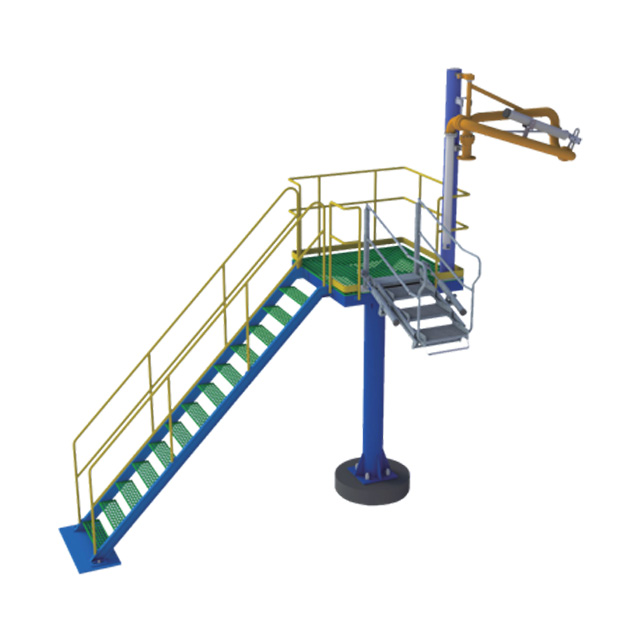
When engineering a land-based fluid transfer hub, facility managers face a critical fork in the road. You must choose between top and bottom loading methodologies. This decision is rarely arbitrary. It is heavily dictated by the chemical signature of the fluid, your existing transport fleet, and stringent local safety mandates.
Top loading requires the operator to route fluids through an open dome situated on the roof of the tanker. While considered an older method, it remains highly relevant. It is often the only viable choice for specific harsh industrial scenarios. For example, transferring molten sulfur, fuming acids, or highly toxic solvents requires keeping hazardous connection points elevated. If a minor weep occurs, the immediate risk of direct chemical exposure to ground personnel is mitigated.
This configuration also dominates railcar logistics. However, personnel must physically climb onto the curved roof of the vehicle to maneuver the heavy arm. Therefore, integrating heavy-duty fall protection infrastructure is an absolute legal requirement to prevent fatal workplace accidents.
Over the last decade, the petroleum and chemical distribution sectors have executed a massive pivot toward bottom loading. Every connection is finalized at ground level utilizing standardized quick-connect API RP 1004 couplers. The empirical advantages of a bottom-configured truck loading rack are impossible to ignore.
Safety improves instantly because the operator never leaves the pavement. This entirely eradicates fatal fall hazards. Efficiency skyrockets as well. Bottom loading permits the simultaneous filling of multiple separate compartments on a single trailer. You hear the heavy clank of several couplers locking into place, and within minutes, a multi-product delivery is ready for dispatch. Vapor recovery is also inherently simpler to manage at ground level.
Feature | Top Loading | Bottom Loading |
|---|---|---|
Operator Safety | Requires elevated work; high fall risk without proper safety cages. | Ground-level operation; zero fall risk. |
Transfer Speed | Slower; typically loads one compartment at a time. | Extremely fast; allows simultaneous multi-compartment loading. |
Vapor Recovery | Requires specialized hatch seals; moderately difficult. | Seamless closed-loop integration at ground level. |
Best Suited For | Harsh chemicals, molten sulfur, railcars. | Refined petroleum, modern tanker fleets, high-volume depots. |
Standard carbon steel pipes and basic rubber seals fall woefully short when confronted with extreme environments. High-stakes logistics require specialized engineering to manage the unique physical states of cryogenic liquids.
Liquefied Natural Gas exists at a punishing cryogenic temperature of minus 162 degrees Celsius. Expose standard carbon steel to this cold, and it shatters like glass. To survive these thermal extremes, cryogenic arms are forged from specialized 316L stainless steel. This material maintains its structural integrity despite severe thermal contraction.
The swivel joints on these arms are engineering masterpieces. They frequently utilize nitrogen-purged chambers that actively block atmospheric moisture from freezing and locking the joint mid-transfer. Because of the extreme volatility, an Emergency Release System featuring double ball valves is mandatory. Should a truck roll forward unexpectedly, the system instantly fires. It seals both ends of the transfer line and snaps the connection apart to prevent a catastrophic gas cloud release.
Moving fluids across the sea requires infrastructure capable of pushing massive volumes while dancing with the ocean's unpredictable rhythm. A static land rack simply cannot handle a ship's heave, sway, surge, roll, pitch, and yaw. Marine loading arms are colossal hydraulic towers engineered with a calculated drift envelope. This is a three-dimensional spatial zone where a vessel can safely float with the tide without ripping the pipe apart.
If violent weather pushes the ship beyond this safe working envelope, automated proximity alarms scream to life. An Emergency Release Coupling activates, safely severing the umbilical connection and protecting millions of dollars of dockside infrastructure.
Historically, commissioning a new transfer bay meant months of chaotic civil engineering, endless hot work permits, and weather delays. Today's procurement trends heavily favor skid-mounted modular architecture. This delivers immediate and measurable benefits in deployment speed.
A skid-mounted loading and unloading station is conceptualized, built, and rigorously pressure-tested within the controlled environment of a manufacturing facility. Every wire is traced. Every pipe is subjected to Factory Acceptance Testing before it ever sees a shipping crate.
By delivering the entire apparatus as a single cohesive block, the chaotic on-site workload is drastically reduced. You simply pour a concrete pad and bolt the main supply lines into place. This plug-and-play methodology bypasses weeks of dangerous on-site welding. It allows a terminal to transition from construction to revenue generation in a fraction of the traditional time.
Industrial markets are volatile. Fixed and unmovable infrastructure can quickly become a liability. Skid-mounted architecture offers inherent scalability. If a depot secures a massive new contract, additional modular skids can be dropped seamlessly into the existing layout. Conversely, if operations shift to a different geographic region, the entire skid can be unbolted and relocated. This preserves the initial capital investment entirely.
Moving highly flammable or corrosive fluids is inherently dangerous. A modern transfer bay is an active and intelligent safety perimeter designed to neutralize human error before it escalates into a disaster.
As hydrocarbons rush through metal pipes at hundreds of gallons per minute, intense friction generates a massive static electrical charge. Without a clear path to dissipate, this static will inevitably spark and ignite surrounding vapors. Advanced grounding controllers continuously monitor the electrical resistance between the truck chassis and the earth. If a grounding clamp slips, the controller instantly kills the pumps.
Spill prevention is equally automated. Optic or thermistor sensors are wired into the automation controller. The moment rising liquid touches the sensor tip, automated valves slam shut in milliseconds. This action is completely independent of the human operator's reaction time.
Electronic interlocks prevent fires, but heavy-duty physical infrastructure is required to keep the human workforce alive. Top-loading procedures force operators to navigate elevated and weather-slicked tanker roofs. Integrating robust safe tanker access equipment changes the dynamic entirely.
Counterbalanced folding stairs driven by pneumatic cylinders glide down to meet varying vehicle heights. Once deployed, heavy steel safety cages envelop the operator's working zone. This creates a physical barrier that makes it impossible to step off the edge. By investing in these structural safeguards, facilities virtually eliminate fatal fall liabilities.
A brief analysis of the global fluid logistics sector reveals a rapid evolution in how these transfer hubs are conceptualized. Driven by tightening environmental regulations and the push for higher throughput, terminals are aggressively transitioning away from manual oversight. The industry is moving toward fully automated and digitally integrated ecosystems.
Specifically, the implementation of Industrial Internet of Things sensors directly onto swivel joints and balancing cylinders is becoming a baseline standard. These smart sensors feed real-time wear-and-tear data back to centralized control rooms. This allows facility managers to execute predictive maintenance rather than reacting to catastrophic leaks. In addition, global mandates demanding near-zero emissions have forced a hardware shift. The integration of hyper-efficient vapor recovery units into the loading rack architecture is no longer an optional upgrade. It is a strict requirement for regulatory survival. Modern loading stations are now viewed as intelligent data hubs just as much as they are mechanical transfer points.
Procuring the optimal infrastructure requires a surgical evaluation of your facility's unique operational DNA. A generic catalog purchase usually leads to operational bottlenecks. Procurement teams must weigh fluid dynamics against site constraints to engineer a bespoke solution.
The chemical personality of your product dictates the materials of construction. Standard refined fuels like diesel play nicely with basic Q235 carbon steel piping and Buna-N seals. However, pumping aggressive hydrochloric acid through that same pipe will eat through the steel in days. Corrosive applications demand PTFE-lined piping and Hastelloy components.
Temperature management is another critical variable. Viscous fluids like heavy bitumen will freeze solid inside the pipes if ambient temperatures drop. Arms handling these stubborn materials must be equipped with steam-jacketed piping or electrical heat tracing to keep the fluid moving smoothly.
Your daily truck volume dictates the structural footprint of the rack. A high-volume depot processing hundreds of trucks daily requires a multi-arm bottom-loading configuration. Standard pipe sizing typically ranges from DN50 for lower flow rates up to DN150 for rapid bulk transfer. Engineers must meticulously calculate the turning radius of fleet vehicles and the maximum reach of the articulated arms to ensure bottleneck-free traffic flow.
The day a system is commissioned is just the beginning of its lifecycle. The long-term profitability of a transfer station hinges entirely on its operational uptime. Neglecting these dynamic mechanical beasts degrades loading speeds and invites disaster.
Because these arms twist and stretch under immense pressure, they suffer continuous mechanical fatigue. Swivel joints are the absolute critical failure points. Their bearings must be greased precisely to manufacturer specifications to prevent locking. Elastomeric seals and O-rings slowly degrade from chemical friction. They require routine pressure testing to catch microscopic weeping before it becomes a hazardous spray. Furthermore, balancing cylinders must be regularly calibrated so the heavy steel arm remains weightless in the hands of the operator.
Every minute a loading bay is shut down for repairs, revenue evaporates. Forward-thinking facility managers minimize this by procuring systems designed explicitly for rapid serviceability. Modular arms allow a technician to unbolt and swap a single worn swivel joint without tearing down the entire rack. By maintaining a strategic on-site inventory of replacement API couplers and seal kits, maintenance crews can execute surgical repairs rapidly. This gets the bay back online before the next fleet of trucks arrives.
The architecture of a fluid transfer station extends far beyond a simple network of pipes. It is the operational heartbeat of industrial logistics. It represents a complex intersection where speed, profitability, and human safety meet. Whether your facility is pushing standard diesel through a basic land rack or managing the cryogenic extremes of liquefied natural gas, the margin for error remains zero.
Selecting the precise equipment, integrating automated fail-safes, and committing to proactive maintenance will shield your terminal from catastrophic hazards. Take the time to audit your current transfer bays today. If your infrastructure is aging or bottlenecking your throughput, it is time to upgrade. We highly recommend partnering with seasoned engineering manufacturers to design custom, site-specific solutions. Visit Loading Arm Tech to explore highly engineered loading arms, skid-mounted systems, and safety access platforms tailored to secure a safer and more profitable operational future for your facility.
A loading arm is the specific articulated pipe mechanism complete with swivel joints and valves that physically bridges the gap between the storage tank and the vehicle. In contrast, a loading rack system encompasses the entire overarching infrastructure. This includes the massive steel canopy supporting the arms, the integrated metering skids, vapor recovery lines, and physical safety access platforms. The arm is just one component. The rack is the complete operational environment.
It revolutionizes safety by replacing unpredictable and easily ruptured flexible hoses with rigid articulated steel piping. Furthermore, it bakes safety directly into the process through electronic interlocks like grounding controllers to eliminate static sparks. Physically, it provides dedicated infrastructure like counterbalanced folding stairs and heavy-duty safety cages. These shield operators from fatal falls and direct chemical exposure while working at dangerous heights.
Yes, but they require fundamentally different engineering philosophies and components. Systems handling standard liquids operate under standard atmospheric pressures and ambient temperatures. Conversely, stations designed for volatile liquids like Liquefied Natural Gas require highly specialized closed-loop vapor recovery lines, high-pressure cryogenic swivel joints, and automated emergency release systems to safely contain extreme pressures.
Because skid-mounted systems are pre-engineered, fully assembled, and pressure-tested in a factory environment, on-site installation is incredibly fast. Traditional custom-built racks can take weeks or months of dangerous on-site welding and civil engineering. In contrast, a skid-mounted unit can often be dropped onto a prepared concrete pad, bolted down, and connected to main supply lines in a matter of days. This drastically reduces facility downtime.
Swivel joints are the most critical moving parts on the arm. Routine maintenance involves applying specific industrial grease to the ball bearings to ensure smooth articulation and prevent metal-on-metal grinding. Additionally, the internal elastomeric seals must be periodically inspected and pressure-tested. Catching seal degradation early prevents hazardous chemical leaks and ensures the arm maintains a hermetically sealed transfer loop.


