

close
Choose Your Site
Global
Social Media
Views: 0 Author: Site Editor Publish Time: 2026-10-18 Origin: Site


Picture a freezing morning at the loading rack. A tanker truck is idling, and the driver is anxiously checking his watch. The asphalt has cooled, thickened, and completely choked the transfer lines. What should be a seamless, routine fill-up has suddenly escalated into a costly operational halt.
Anyone who has pumped bitumen knows it fights you every inch of the way. The exact second this heavy petroleum product leaves the insulated comfort of a storage tank and encounters ambient air at the loading rack, it begins losing thermal energy at an alarming rate. This rapid cooling solidifies the fluid into a stubborn, tar-like plug.
To combat this thermodynamic nightmare, engineers developed specialized heated transfer systems. These mechanical marvels actively maintain the precise temperature required to keep heavy, sluggish fluids flowing smoothly.
This comprehensive guide will dissect how these articulated systems function. We will explore the specific thermal technologies available and demonstrate how upgrading your infrastructure can drastically improve terminal throughput, operator safety, and bottom-line profitability.
Rapid Heat Loss is Costly: Bitumen and asphalt demand strict temperature maintenance, typically between 150 to 200 degrees Celsius. Any unexpected drop causes viscosity to spike exponentially, leading to severe clogs and logistical downtime.
Continuous Thermal Control: Engineered transfer systems utilize specialized technology like steam jackets or electrical tracing to maintain product temperature from the storage manifold all the way into the transport vehicle.
Superior to Traditional Hoses: Unlike standard rubber or composite industrial hoses, a rigid mechanical arm offers unmatched thermal insulation, higher safety ratings, and a significantly longer operational lifespan.
Customizable Heating Methods: Facility managers can select between steam-jacketed setups and electrical heat tracing based on their existing terminal utilities and specific thermostatic requirements.
Measurable ROI: Upgrading to dedicated heated equipment reduces routine maintenance, prevents product loss, and accelerates truck turnaround times at the loading platform.
Transferring heavy crude oils and asphalt presents a unique set of thermodynamic hurdles. Unlike light hydrocarbons or water, the physical properties of these substances are entirely dependent on thermal energy.
Bitumen is a highly viscous, semi-solid form of petroleum. To remain in a fluid, pumpable state, it must be kept at elevated temperatures. The relationship between its temperature and kinematic viscosity is fiercely non-linear. Consequently, even a minor dip in temperature causes the viscosity to increase dramatically. Leaving the heavily insulated storage tank, the product is immediately exposed to cold pipe walls. Without active thermal intervention, heat bleeds through the carbon steel in a matter of minutes.
Standard transfer methods act as thermal bridges. Unheated pipes, traditional rubber hoses, or poorly insulated flange connections draw precious heat away from the fluid. This creates localized cold spots. In these vulnerable areas, the liquid begins to crystallize and build up along the inner walls of the transfer equipment. This progressive buildup reduces the internal diameter of the pipe, restricting flow rates and forcing pumps to overexert themselves.
When the product solidifies completely, the resulting blockage triggers a cascade of operational failures across the facility. Transfer rates plummet to zero, causing tanker trucks to back up at the terminal gates and incur hefty demurrage charges. Furthermore, operators are often forced to manually clear these blockages. This desperate situation sometimes leads to the use of unsafe external heating methods, which introduce severe fire risks into a highly volatile petrochemical environment.
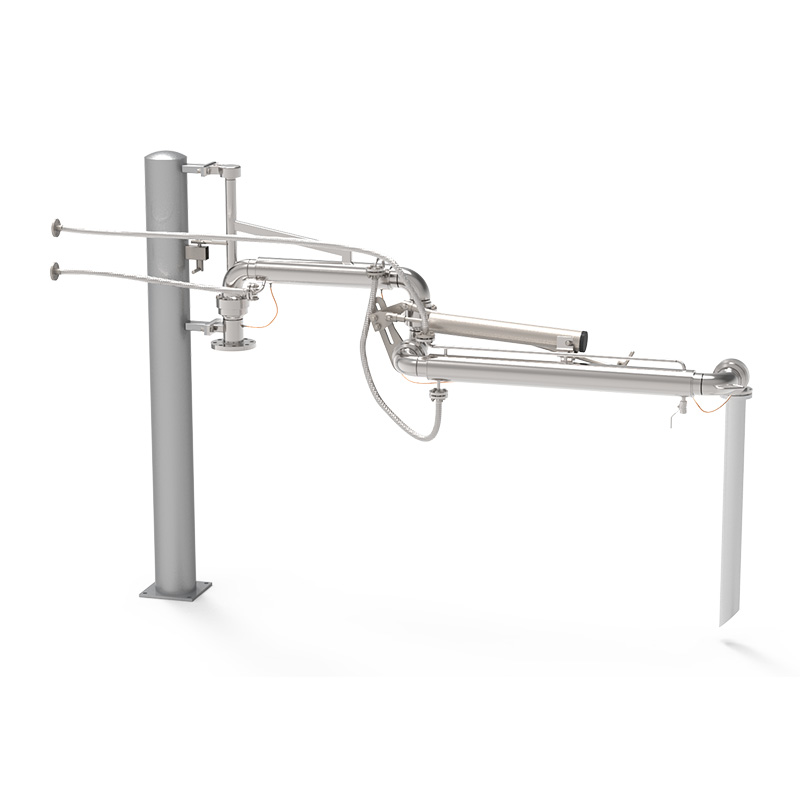
To permanently resolve the rapid cooling of heavy petroleum products, industrial engineers created the bitumen loading arm. This is a highly specialized, articulated mechanical structure designed specifically for the safe, efficient transfer of temperature-sensitive fluids between a storage terminal and a transport vehicle.
Standard loading arms are typically constructed from single-walled carbon steel or aluminum, built primarily for ambient-temperature fluids like diesel or water. In stark contrast, a system engineered for heavy asphalt integrates multiple complex layers of thermal technology. It features robust structural supports capable of handling the added weight of thick insulation, specialized high-temperature seals, and intricate swivel joints that allow for a full range of motion without ever compromising the heating envelope.
The fundamental operating principle of this equipment is uninterrupted thermal application. Heat is actively and continuously applied to the inner product pipe. By doing so, any thermal energy lost to the surrounding environment is instantly replenished. This guarantees that the fluid remains in a low-viscosity state throughout the entire journey.
Selecting the appropriate heating technology is a critical decision for facility engineers. The choice between utilizing steam or electricity depends heavily on the terminal's existing infrastructure, local utility costs, and precise environmental requirements.
Recent shifts in global petrochemical logistics show a massive pivot toward automated thermostatic controls. Terminals are moving away from brute-force heating methods. Instead, facility managers are adopting smart tracing systems that adjust wattage dynamically based on ambient temperature drops. This industry trend is not just about saving energy; it is about preventing the thermal degradation of premium polymer-modified asphalt, ensuring product quality remains pristine from tank to truck.
Steam jacketing relies on a classic pipe-within-a-pipe architectural design. Hot steam or thermal fluid flows continuously through the outer jacket, transferring intense heat through the wall of the inner product pipe directly to the fluid. This method is exceptionally well-suited for facilities that already possess an abundant supply of industrial steam. Specifically, steam provides incredibly uniform heat distribution, effectively eliminating the risk of localized cold spots.
Electrical heat tracing takes a more modern approach. Specialized electrical heating cables are wrapped directly around the inner product pipe. These heavy-duty cables are then heavily insulated and sealed beneath a protective metal cladding. Terminals without existing steam infrastructure benefit immensely from this setup. They offer pinpoint temperature control via digital thermostats, preventing the product from overheating.
Feature | Steam Jacketed Systems | Electrical Heat Tracing |
|---|---|---|
Heating Medium | Industrial steam or hot thermal oil | Electrical resistance cables |
Temperature Control | Broad heating, harder to fine-tune | Precise digital thermostatic control |
Maintenance Needs | High. Requires steam trap and valve checks | Low. Periodic sensor calibration |
Best Application | Refineries with existing boiler infrastructure | Remote racks and polymer-modified asphalt |
A standard fluid transfer pipe cannot simply be wrapped in a blanket of insulation and expected to handle boiling asphalt. A true high-viscosity liquid loading arm is engineered from the ground up. High-quality manufacturers build these systems to stringent specifications, often utilizing carbon steel or 304L/316L stainless steel for the wetted parts, supporting nominal diameters from DN50 up to DN150.
The swivel joint is the critical moving component that allows the rigid pipe to articulate. Standard swivels fail rapidly when exposed to asphalt because the high-temperature product seeps into the ball bearings and bakes into a solid mass. To prevent this, heated systems utilize fully jacketed or heat-traced swivel joints. These joints are equipped with advanced PTFE or fluoroelastomer seals designed to maintain structural integrity up to 250 degrees Celsius, preventing dangerous leaks while ensuring smooth mechanical rotation under pressures reaching 2.5 MPa.
Generating heat is only half the battle. Retaining it is equally vital. To maximize thermal efficiency, the entire arm is tightly wrapped in industrial mineral wool. Because loading racks face constant exposure to the elements, this insulation is shielded by highly durable aluminum cladding. This protective layer keeps the heat locked inside the pipe while preventing corrosive coastal air from degrading the insulating materials.
The addition of steam jackets and thick insulation makes these arms significantly heavier than standard models. To ensure the equipment remains easy for a single operator to maneuver, robust counterbalance systems are integrated into the base design. Utilizing heavy-duty spring cylinders, these mechanisms neutralize the weight of the arm, allowing for precise, low-effort positioning.
Investing in specialized transfer infrastructure requires initial capital expenditure, yet the long-term operational returns easily justify the cost for high-volume heavy oil terminals.
Time is money at the loading rack. When the product is maintained at its absolute optimal viscosity, flow rates are maximized. Pumps can operate at peak efficiency without fighting against thickened, sluggish fluid. This seamless flow translates directly to faster loading times, allowing the terminal to process significantly more trucks per shift.
Traditional transfer methods often involve operators wrestling with heavy, scalding-hot composite hoses. This archaic process leads to severe fatigue and a terrifying risk of thermal burns if a hose ruptures. In contrast, a rigid mechanical arm carries its own weight. Instead of two operators dragging a heavy hose across a slippery platform, a single worker can gently guide the insulated equipment into place.
In colder climates, ambient freezing temperatures can cause unheated transfer lines to freeze solid within minutes. Terminals relying on flexible hoses often face crippling seasonal shutdowns during the winter months. Heated arms provide an impenetrable thermal shield, ensuring operations remain uninterrupted regardless of plummeting external temperatures.
Rubber and composite hoses degrade rapidly when subjected to the extreme heat and harsh chemical composition of petroleum products. Rigid steel arms are built for endurance. When properly maintained, they offer a reliable operational lifespan of 15 to 20 years, practically eliminating recurring replacement costs.
To maximize the return on investment and ensure the equipment reaches its expected two-decade lifespan, facility managers must implement strict operational protocols on the platform.
Thermal shock is a leading cause of premature equipment failure. Operators must never open the main product valve and introduce boiling fluid into a freezing cold steel pipe. The arm must be allowed to reach its target operating temperature well before the transfer begins. This vital step prevents immediate crystallization at the pipe walls and protects the metal welds from rapid, damaging thermal expansion.
Despite being engineered for the harshest conditions, swivel joints are still mechanical moving parts that experience friction. They must be regularly lubricated using manufacturer-specified high-temperature grease. Applying the wrong lubricant will cause the grease to bake into a solid carbon deposit, eventually destroying the internal bearings.
Perhaps the most crucial daily practice is post-transfer purging. Product must never be left to sit idle in the arm after a truck departs. The arm must be properly sloped for gravity draining or actively blown out using a dedicated nitrogen purge system, ensuring the lines are completely empty before powering down.
Procuring a specialized heated loading arm is not an off-the-shelf transaction. It requires a collaborative engineering process based on the exact parameters of your terminal.
First, manufacturers need to know the specific properties of the fluid being transferred. This includes the exact grade of the asphalt, its specific gravity, and its precise kinematic viscosity at the intended transfer temperature. This critical data dictates the required internal pipe diameter and the thermal load the heating system must overcome.
Furthermore, you must clearly define your temperature requirements. Specify both the target product temperature and the environmental extremes of your location. The engineering team must know the absolute minimum ambient temperature the facility experiences during deep winter to calculate the necessary thickness of the insulation.
Finally, the physical constraints of the loading rack will dictate the mechanical design. You must determine whether the operation requires top loading through a hatch or direct bottom loading. Providing the required reach and the varied sizes of the tanker fleet ensures the final product will integrate seamlessly with your existing piping manifolds.
Stop letting temperature drops dictate your loading schedule and erode your profit margins. Transitioning away from archaic traditional hoses to a rigid, engineered transfer system is a strategic investment that quickly pays for itself. If you are ready to eliminate transfer bottlenecks and drastically improve terminal safety, visit Loading Arm Tech today to explore high-performance thermal transfer solutions tailored specifically for your heavy oil facility.
Most engineered heated loading systems can comfortably accommodate product temperatures up to 250 degrees Celsius. The absolute maximum temperature limit is generally dictated by the specific seal materials chosen for the swivel joints and the type of heating medium utilized by the facility.
While applying bolt-on electrical tracing to existing pipes is theoretically possible, it is strongly advised against for high-viscosity fluids. Standard arms lack the specialized high-temperature swivel joints required to handle extreme heat safely. Furthermore, they do not possess the structural reinforcement necessary to carry the significant added weight of heavy insulation without risking mechanical failure.
Top loading remains the industry standard for high-viscosity liquids, primarily due to the traditional design of asphalt tanker trucks. However, heated bottom loading arms are becoming increasingly available. Bottom loading offers superior operator safety by completely eliminating the need for personnel to climb atop the vehicles, provided the incoming tanker fleet is properly equipped with compatible bottom-loading valves.
Polymer-modified bitumen typically requires tighter thermostatic control than standard asphalt. The ideal transfer temperature usually ranges between 160 to 180 degrees Celsius. Exceeding this range can degrade the polymer additives, while dropping below it will cause the product to become unpumpable. This is why electrical heat tracing with digital thermostats is highly recommended for these specific grades.
If a blockage occurs due to power failure or improper purging, operators should never use open flames or blowtorches. The safest method is to activate the arm's built-in heating system and allow it to gradually melt the plug over several hours. For severe clogs, specialized industrial steam wands or hot oil circulation systems can be used to safely introduce heat back into the core pipe.
When operated correctly and maintained strictly according to the manufacturer's specifications, a high-quality steel heated arm boasts an operational lifespan of 15 to 20 years. Achieving this longevity requires strict adherence to routine seal replacements, regular swivel joint lubrication, and proper management of the thermal fluids or electrical systems.
The power requirements depend entirely on the specific heating technology selected. Steam-jacketed arms must be hard-piped directly into the facility's existing industrial boiler. Conversely, electrical heat-traced arms require a dedicated industrial electrical supply and a specialized control panel configured to match the specific voltage available at your site like 220V, 480V, or 600V.


