

close
Choose Your Site
Global
Social Media
Views: 0 Author: Site Editor Publish Time: 2026-09-23 Origin: Site


The transition from traditional flexible hoses to rigid loading infrastructure represents a non-negotiable upgrade for modern ports facing strict environmental mandates. Terminals must process vessels faster while completely eliminating hazardous leaks. The stakes in ship-to-shore fluid transfer are simply too high to ignore. Minor equipment failures can quickly lead to catastrophic spills, heavy regulatory fines, and extended terminal downtime. Protecting sensitive coastal ecosystems requires flawless operational reliability every single day.
This guide provides a detailed technical and procurement evaluation framework. Terminal operators and engineers will discover how to specify the exact equipment they need based on specific fluid types, complex environmental loads, and uncompromising safety compliance. By understanding these core design criteria, you can secure seamless product transfers and proactively safeguard your critical port infrastructure.
Specifying a marine loading arm requires precise operational data, including drift envelopes, manifold heights, and local wind/seismic loads.
Application-specific engineering is critical; an oil terminal equipment setup requires different material grades and sealing systems compared to an LNG marine loading arm.
Integration of advanced safety features like Emergency Release Systems (ERS) and reliable thermal flow switches prevents costly spills and protects port infrastructure.
Choosing the right marine loading arm manufacturer depends on their ability to meet OCIMF guidelines, provide global compliance documentation, and offer long-term maintenance support.
Modern ports handle massive volumes of volatile media around the clock. Upgrading your port loading equipment fundamentally reduces catastrophic operational risks. Many older terminals still rely heavily on flexible hoses for transferring liquids. Hoses present constant failure risks because they degrade quickly under immense pressure and daily weather exposure. Rigid articulated arms provide vastly superior long-term reliability. They utilize steel pipes and mechanical joints to create a highly durable containment boundary. This rigid structure drastically reduces the chance of sudden ruptures.
Automated and hydraulically operated arms fundamentally change your throughput reliability. They eliminate the heavy manual labor required to maneuver giant hoses into place. Hydraulic systems accelerate turnaround times for varying vessel sizes. A single operator can precisely guide a massive arm to a ship manifold using remote controls. This reduces physical connection times from hours down to minutes. Faster connections mean ships spend less time at the berth. You instantly increase your terminal capacity.
Modern safety standards increasingly demand rigid and strictly controlled transfer methods. Organizations like OCIMF (Oil Companies International Marine Forum) set clear compliance baselines for hazardous media. Regulatory bodies simply no longer tolerate the inherent risks of unsupported hoses. They require engineered systems capable of maintaining absolute integrity during pressure surges. Facilities must adapt to these rigid standards to maintain their operating licenses and insurance coverages.
Table 1: Flexible Hoses vs. Rigid Articulated Arms
Feature | Flexible Hoses | Rigid Articulated Arms |
|---|---|---|
Structural Integrity | Prone to wear, kinking, and UV degradation | High durability using metal piping |
Connection Speed | Slow, requires heavy manual labor | Fast, often hydraulically automated |
Safety Compliance | Bare minimum, high spill risk | Meets stringent OCIMF standards |
Environmental Stress | Highly vulnerable to wind and current shifts | Engineered to absorb complex dynamic loads |
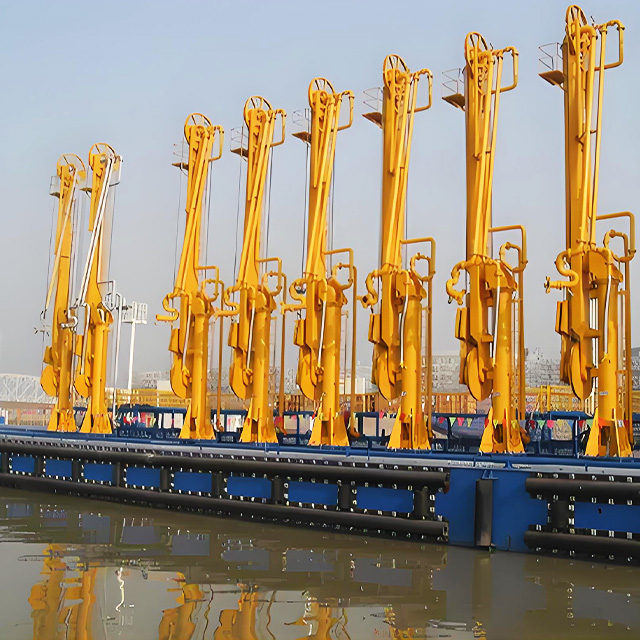
Every ship to shore transfer arm requires a precisely calculated 3D working envelope. Ports experience constant tidal shifts. Drafts change dynamically as vessels continuously load or unload cargo. Engineers must define exactly how far the arm can safely reach. We account for acceptable vessel surge, sway, and heave during operations. This mathematical boundary dictates safe operational limits at the berth. Ignoring these specific drift factors easily leads to critical over-extension. Operators face severe equipment damage if the vessel moves beyond the designed physical limits. A well-engineered envelope guarantees the arm flexes naturally alongside the floating vessel.
Terminal locations expose equipment to brutal environmental realities. Engineers must meticulously account for heavy deadweight and intense wind loads. Coastal facilities often face hurricane-force winds exerting massive pressure on tall structures. Cold-weather ports must calculate rapid ice accumulation. Thick ice adds tremendous unwanted weight to the articulated pipes. Seismic activity poses another critical engineering requirement for specific regions. The base riser and structural supports must absorb earthquake tremors without fracturing. We reinforce concrete foundations and utilize vibration-dampening materials to ensure structural survival. Comprehensive environmental load mapping ensures the system stands strong during extreme weather events.
Swivel joints act as the absolute mechanical heart of any articulated system. They maintain complete fluid containment under immense physical stress. These precision-engineered components allow multi-axis movement while holding high-pressure seals perfectly intact. We select carbon steel primarily for non-corrosive media applications. However, we choose stainless steel or highly specialized alloys for aggressive chemicals. Engineers must match the metal grade directly to the corrosiveness and temperature of the transferred media.
Chart 1: Material Grade Selection Guide
Transferred Media | Typical Temperature | Recommended Material Grade |
|---|---|---|
Crude Oil / Diesel | Ambient | Carbon Steel |
Aggressive Chemicals (Acids) | Ambient to High | 316L Stainless Steel / Hastelloy |
Liquefied Natural Gas (LNG) | -162°C (Cryogenic) | 316L Stainless Steel (Cryo-grade) |
Handling crude oil and refined petroleum products demands specific engineering configurations. A standard oil terminal equipment setup focuses heavily on maintaining massive flow rates. High-capacity pipes reduce total vessel turnaround times significantly. These systems utilize incredibly robust swivel joints capable of handling thick, abrasive crude. Furthermore, modern emission regulations require standard vapor return lines. These parallel pipes capture harmful volatile organic compounds (VOCs) displaced during loading. They direct dangerous vapors back into shore-side recovery systems. This prevents toxic atmospheric venting and ensures strict environmental compliance at the dock.
Chemical transfers introduce severe aggressive media compatibility challenges. A dedicated chemical marine loading system requires highly specialized seals, such as PTFE. Standard rubber seals dissolve quickly when exposed to harsh solvents or acids. We implement strict closed-loop handling to prevent operator exposure to toxic vapors. Facilities also require dedicated nitrogen purge systems. These clear the lines entirely before disconnection occurs. Leaving residual chemicals inside the pipes causes rapid corrosion and severe safety hazards. Engineers mandate strict metallurgical reviews before finalizing any chemical transfer system design.
Natural gas liquefaction introduces extreme cryogenic realities at -162°C. A certified LNG marine loading arm focuses entirely on managing this intense thermal shock. Standard carbon steel becomes dangerously brittle and shatters at these temperatures. Engineers dictate strict metallurgical requirements, primarily using 316L stainless steel for all wetted components. You must utilize specially designed cryogenic swivel joints. These joints feature complex dynamic seals that shrink predictably as temperatures plummet. Stringent ice-prevention and heavy insulation designs wrap the pipes. They stop thick atmospheric moisture from freezing onto the exterior, which would otherwise lock the mechanical joints.
A Double-Valve Emergency Release System (ERS) provides the ultimate fail-safe mechanism. It actively detects any out-of-bounds vessel movement in real time. If a mooring line snaps, the system triggers automatically before the main structure breaks.
Detection: Sensors identify when a vessel crosses the pre-defined safety envelope.
Isolation: Two interlocked mechanical valves close simultaneously, trapping fluid inside both the arm and the ship's manifold.
Separation: A mechanical collar violently releases, physically separating the arm from the ship.
Retraction: Hydraulic cylinders pull the arm safely back toward the dock.
This coordinated sequence isolates the fluid flow completely. It safely disconnects without spillage or structural damage to the primary equipment.
Modern terminal automation relies on highly reliable instrumentation. We integrate advanced thermal flow switches directly into the primary transfer lines. These sensors continuously monitor live flow states and detect dangerous pressure spikes instantly. If the system registers an abnormal surge, it triggers automatic shutoffs immediately. This rapid automated response prevents catastrophic overflows or spills on the vessel deck. Relying solely on manual operator reaction times is a common safety mistake. Automated flow monitoring acts as an uncompromising digital guardian over the entire transfer process.
Continuous tracking of the physical position feeds critical data directly to the control room. A Position Monitoring System (PMS) utilizes precise rotary encoders on every joint. These sensors map the exact 3D location of the manifold connection continuously. The system provides early warning alarms before physical limits are breached. If the vessel begins drifting due to changing tides or high winds, the control room sees a visual alert. Operators can then halt the pumping process and communicate with the ship's captain. This proactive monitoring stops structural stress long before emergency separation becomes necessary.
Every port features entirely unique spatial and environmental constraints. You must assess whether the marine loading arm manufacturer relies on rigid off-the-shelf templates. High-quality vendors conduct exhaustive site-specific structural and fluid dynamics calculations. They model your exact berth dimensions, tide tables, and vessel sizes before manufacturing begins. A generic design often fails to reach smaller barges or overextends when connecting to massive supertankers. Look for engineering teams that provide comprehensive 3D modeling and structural stress reports tailored specifically to your terminal layout.
Reputable engineering firms transparently verify their adherence to international codes. Your chosen manufacturer must demonstrate strict compliance with OCIMF, ASME, and EN standards. They should provide comprehensive local regulatory certifications upon request. A common mistake is purchasing equipment lacking documented weld procedures or material test reports. You need a transparent paper trail proving every steel pipe and swivel joint meets global safety baselines. Request detailed certification matrices during your initial vendor evaluation phase.
The global market reveals a strong rise in high-quality, China-built Marine Loading Arm solutions. Geography matters far less than internal factory protocols. You must evaluate their specific QA/QC processes rigorously. Factory acceptance testing (FAT) remains a non-negotiable step. The vendor must assemble and pressure-test the entire system before shipping it to your port. Material traceability guarantees they used genuine stainless steel instead of cheaper, low-grade alternatives. Focus your evaluation heavily on their documented testing procedures rather than their physical country of origin.
Long-term operational success depends heavily on responsive after-sales support. You must evaluate the immediate availability of critical spare parts, especially custom seals. Ask the manufacturer for data regarding the mean time between failures (MTBF) for their swivel joints. Determine their ability to provide on-site commissioning and periodic inspection services globally. A robust piece of equipment becomes useless if you cannot source replacement parts during a sudden breakdown. Establish clear service level agreements before signing final procurement contracts.
Verify site-specific engineering and 3D modeling capabilities.
Demand transparent OCIMF and ASME compliance documentation.
Review strict factory acceptance testing (FAT) procedures.
Confirm global availability of spare parts and field technicians.
A sophisticated transfer system represents a critical, long-term infrastructure investment. Diligent upfront engineering directly mitigates massive operational risks and prevents devastating environmental disasters. Terminal operators must move beyond outdated flexible hoses to ensure true global compliance. Precise material selection and integrated safety systems like ERS keep your personnel and local ecosystems safe.
Procurement and engineering teams must compile their specific terminal parameters immediately. Gather your fluid types, maximum flow rates, and localized environmental data before initiating any vendor discussions. Having this data ready accelerates the custom engineering process significantly.
Do not leave your terminal safety to chance. Request a technical consultation today or download a comprehensive specification checklist to evaluate your current port infrastructure.
A: You must detail a core data checklist. Provide the exact media type, maximum flow rate, operating pressure, and temperature range. You also need precise vessel sizes (DWT), manifold flange details, tide variations, and local environmental loads like wind and seismic data.
A: An ERS performs a safe mechanical separation. Two interlocked valves close simultaneously to seal both the arm and the ship's manifold. A mechanical collar then triggers a structural disconnect. This prevents structural damage and stops spills if a vessel drifts too far.
A: With proper routine maintenance, they operate safely for 20 to 30 years. You must perform regular seal replacements, lubricate swivel joints, and ensure operators adhere strictly to the engineered physical design limits.
A: Manual arms are utilized for smaller, lighter applications where operators physically maneuver the equipment. Hydraulic arms are absolutely essential for larger diameters, high-reach requirements, and complex automated control systems requiring remote operation.


