

close
Choose Your Site
Global
Social Media
Views: 0 Author: Site Editor Publish Time: 2026-09-19 Origin: Site


Terminal throughput, operator safety, and environmental compliance directly dictate the success of your fluid transfer operations. If you manage an oil depot or a logistics terminal, you understand these high stakes. Upgrading existing infrastructure or building new loading bays represents a major capital expenditure. Choosing between top and bottom transfer configurations remains a critical defining decision for your facility. This guide provides an evidence-based evaluation of both setups. We focus heavily on operational realities, vapor recovery mandates, and retrofitting risks. Facility engineers and procurement teams will find actionable guidance here to specify the exact right system. You will learn how to accurately evaluate current bottlenecks, align with stringent safety standards, and navigate physical spatial constraints. By deeply understanding these mechanical and environmental factors, you can effectively future-proof your loading racks and consistently streamline tank truck transfer operations.
Efficiency: Bottom loading arms generally reduce tank truck turnaround times by allowing multiple compartments to be loaded simultaneously while the operator remains safely on the ground.
Compliance & Safety: Stringent VOC emission regulations favor bottom loading combined with a closed loading system and a vapor recovery loading arm.
Legacy Infrastructure: Top loading remains a viable, cost-effective solution for specific unretrofitted railcars, specialized chemical applications, and mixed-fleet terminals where trucks lack bottom adapters.
Supplier Selection: The right choice relies heavily on site-specific spatial constraints, existing pipework, and the engineering support provided by your top loading arm supplier or bottom loading arm manufacturer.
Every facility faces unique constraints during daily operations. To choose the right transfer equipment, you must first identify where your current bottlenecks exist. Operations managers often notice that throughput delays stem from outdated loading procedures. You should analyze the current cycle times per tank truck. Observe your loading bays during peak hours. Identify if operators spending time connecting and disconnecting at the top hatch cause structural bottlenecks. Every minute an operator spends climbing delays the next incoming truck.
Safety and liability incidents represent another crucial metric. You must critically assess your historical data on slip-and-fall incidents. Operating at heights on top of a truck introduces significant risk. Furthermore, analyze operator exposure to hazardous fumes. Open-hatch loading often vents harmful vapors directly into the operator's breathing zone. These safety risks translate to higher insurance premiums and severe liability concerns.
Environmental and regulatory pressures play a decisive role today. Local environmental agencies continually tighten compliance requirements. You must evaluate regional rules regarding vapor recovery and overfill protection. Stringent mandates often force terminals to transition away from traditional open-hatch operations. Integrating modern petroleum loading equipment helps facilities meet these strict environmental criteria.
Finally, consider equipment standardization across your facility. You need to ensure the compatibility of new systems with the incoming vehicle fleet. For example, terminals servicing API RP 1004 compliant tank trucks require specific connections. Understanding your fleet composition dictates the mechanical direction of your loading bay upgrades.
A Top Loading Arm facilitates fluid transfer directly via the manhole or top connection of a tank truck or railcar. Operators lower a drop tube into the vehicle to deliver the product. While older facilities heavily rely on this method, it still serves distinct and vital operational purposes.
We see optimal scenarios for top configurations in highly specific applications. Many facilities service legacy mixed fleets. These older trucks often lack bottom-loading ports. Terminals handling highly specialized, corrosive, or high-temperature chemicals also prefer top access. Harsh chemicals degrade bottom seals quickly, creating severe maintenance risks. Additionally, railcar loading continues to rely on top access as the standardized industry norm.
Despite their utility, top configurations carry inherent risks and mechanical limitations. To maintain a safe environment, you must adhere to several critical guidelines.
Install robust fall protection: Top access requires extensive safety infrastructure. You must install secure gangways and safety cages to prevent severe operator falls.
Mitigate static electricity: Splash loading poses a high risk of static buildup. You must ensure all drop tubes are properly sized, submerged correctly, and thoroughly grounded.
Optimize loading sequences: Sequential loading of multi-compartment tanks takes longer. You should train operators to sequence compartments efficiently to minimize downtime.
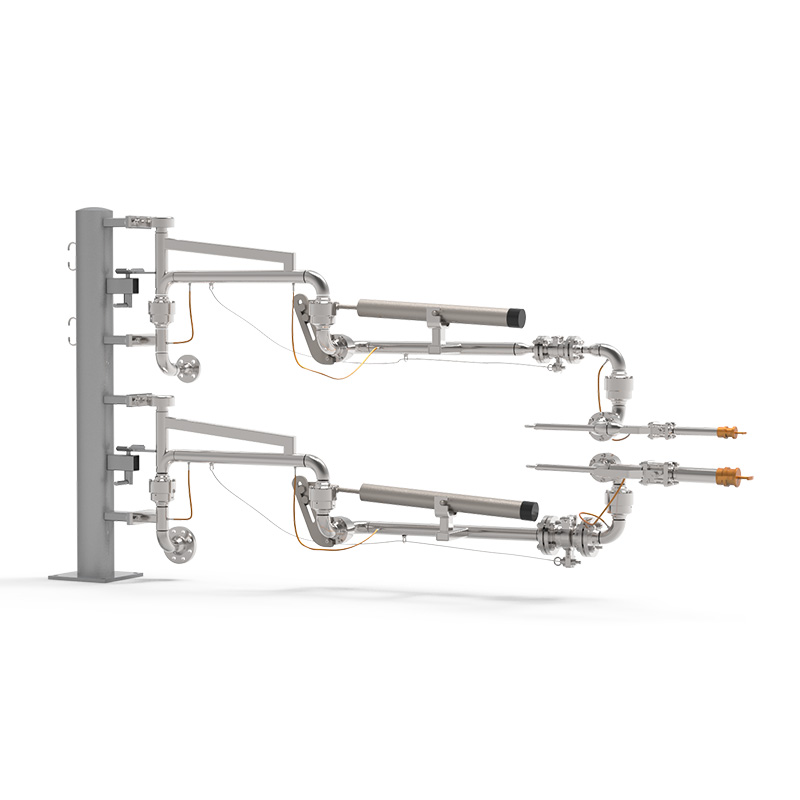
A Bottom Loading Arm connects directly to the API valves located at the base of the tank truck. This system completely removes the need to access the top of the vehicle. Modern logistics terminals strongly favor this configuration for high-volume petroleum transfer.
The performance advantages are immediate and measurable. Ergonomics and safety drastically improve. The operator remains securely at grade level throughout the entire process. This approach eliminates fall hazards entirely and significantly minimizes physical strain. Throughput scalability also sees massive gains. A single operator can connect multiple crossing arms simultaneously. You can load different fuel grades into separate compartments at the exact same time.
Vapor management acts as a primary driver for this technology. Connecting at the base naturally forms a highly effective closed loading system. You can easily capture displaced VOCs to protect operators and the environment. This setup requires vehicles equipped with standardized bottom-loading adapters, known as API couplers, alongside compatible overfill prevention systems.
Failing to verify truck fleet API compatibility before installation.
Ignoring crossover interference when designing the mounting envelope.
Neglecting to install independent grounding monitors alongside the new arms.
To make a sound engineering decision, you must objectively compare both configurations. Different operational environments demand different mechanical priorities. Bottom configurations excel in high-volume, multi-compartment scenarios. Simultaneous product delivery drastically reduces cycle times. Conversely, top loading remains sufficient for single-bulk transfers where speed holds less priority.
Capital expenditure varies significantly between the two systems. A top configuration features a lower baseline equipment cost. However, you must factor in the expensive safety platforms required for compliance. Bottom setups require a higher initial investment in metering, API couplers, and safety interlocks. Yet, they substantially lower structural rack costs by eliminating massive elevated platforms.
Safety considerations strongly favor operating at grade. Grade-level operations drastically reduce working-at-height liabilities. This approach also limits hazardous vapor exposure, especially when utilizing a dedicated vapor recovery loading arm. Maintenance requirements also differ. Bottom systems require regular, stringent inspections of API couplers and dry-break seals. Top systems demand frequent maintenance of drop tubes, heavy vapor plates, and gangway hydraulics.
System Performance Evaluation
Evaluation Criteria | Top Loading Systems | Bottom Loading Systems |
|---|---|---|
Cycle Time & Flow Rates | Slower; requires sequential compartment filling. | Faster; supports simultaneous compartment filling. |
Capital Expenditure | Lower arm cost; high safety platform structural costs. | Higher arm/metering cost; lower structural rack costs. |
Safety & Ergonomics | High fall risk; requires extensive operator exertion. | Minimal fall risk; operators work safely at ground level. |
Maintenance Needs | Focus on drop tubes, vapor plates, and gangways. | Focus on API couplers, dry-break seals, and interlocks. |
Upgrading your facility introduces distinct implementation constraints. You cannot simply swap one system for another without thorough site analysis. Spatial constraints dictate your equipment selection. Different tank truck loading arm models require specific mounting envelopes. A-frame or spring-balanced models need precise island spacing. Proper spacing prevents arm interference when crossing hoses during multi-grade transfers.
Piping and metering upgrades represent a significant engineering hurdle. Retrofitting an older rack involves complex mechanical adjustments. You must reroute overhead supply lines down to ground level. This process involves updating preset controllers and installing new grounding monitors. You will also need to adjust pump pressures to accommodate new flow dynamics.
Downtime phasing requires careful project management. Transitioning a live, operational oil depot disrupts daily revenue. You must coordinate staggered bay closures to keep the terminal operational. Evaluate exactly how quickly the new system can be commissioned to minimize operational pauses.
Unforeseen costs frequently derail retrofitting budgets. Hidden expenses often lie in upgrading concrete foundations. Old islands might lack the structural integrity to support new, heavy arm risers. Integrating new vapor recovery piping with legacy storage tanks also introduces unexpected mechanical complexities.
Partnering with the right equipment provider guarantees a smoother installation. You need a partner who understands complex fluid dynamics and structural engineering. When evaluating a bottom loading arm manufacturer, you must look for rigorous engineering validation. Ask if they provide precise 3D CAD modeling. Advanced modeling verifies envelope clash detection before fabrication begins. This prevents expensive modifications in the field.
Material and seal suitability directly impacts equipment longevity. Scrutinize the swivel joint design offered by the manufacturer. Determine if a split-flange or threaded design best suits your operation. You must also evaluate seal materials like PTFE or Viton against your specific fluid specifications. Harsh chemicals and extreme ambient temperatures require highly specific seal compounds.
Post-sale support proves just as vital as the initial purchase. Assess the availability of spare seal kits and API couplers. A reliable top loading arm supplier offers localized field service. Rapid access to technicians for installation, calibration, and emergency repairs prevents prolonged facility downtime.
Take proactive steps before requesting quotes. Compile comprehensive site layout drawings, precise fluid data sheets, and accurate truck fleet specifications. Provide these documents to prospective partners. Request a formalized, engineered proposal rather than attempting to buy standard, off-the-shelf components.
Choosing the correct fluid transfer equipment defines your terminal's operational success. Top access configurations remain an absolute necessity for specific legacy applications and specialized chemical transfers. However, bottom-access setups stand as the clear industry standard for high-volume petroleum depots. They prioritize critical operator safety, rapid throughput speed, and strict vapor control.
Do not make a final decision based on initial hardware costs alone. You must rigorously model the return on investment based on realistic turnaround time improvements. Factor in the financial value of eliminated fall-risk liabilities and guaranteed environmental compliance. These operational gains frequently offset higher initial equipment investments.
Take decisive action today. Engage with a highly qualified engineering team to conduct a comprehensive site audit. Provide them with your specific throughput goals and spatial limitations. Request a customized technical specification explicitly designed for your terminal's exact operational requirements.
A: Yes, by using custom vapor plates (hatch seals) and integrating a dedicated vapor return line, though it is less efficient than a bottom-loading closed system.
A: Standard 4-inch API bottom loading arms typically handle flow rates between 400 and 600 gallons per minute (GPM), depending on pump pressure and fluid viscosity.
A: While diesel has lower volatility than gasoline, local environmental regulations (like EPA or regional equivalents) often mandate vapor recovery for all hydrocarbon loading to prevent odor and fugitive emissions.
A: Routine visual inspections are required monthly, with seal replacements generally recommended every 3 to 5 years, highly dependent on operational frequency and chemical compatibility.


