

close
Choose Your Site
Global
Social Media
Views: 0 Author: Site Editor Publish Time: 2026-09-16 Origin: Site


Traditional hose transfers constantly expose high-volume operations to severe daily risks. Frequent spills, toxic vapor leaks, and rapid hose wear threaten site safety continuously. They also disrupt terminal workflows. By contrast, engineered articulating systems provide unmatched reliability in demanding environments.
We define a Loading Arm as purpose-built fluid transfer equipment comprising rigid pipes, swivel joints, and advanced balancing mechanisms. It securely connects fixed facility piping to transport vessels like tank trucks, railcars, or marine ships.
This article transitions you from basic concept awareness to advanced, procurement-ready knowledge. You will learn about modern configurations, strict safety compliance, and specific engineering requirements. By the end, you will understand exactly how to specify and select the right systems to safeguard your terminal operations effectively.
Primary Function: Loading arms eliminate the physical strain and safety hazards of heavy hoses, ensuring leak-free, high-throughput fluid transfers.
Configuration Shifts: Bottom loading systems are rapidly becoming the industry standard over top loading due to superior vapor recovery and operator safety.
System Integrity: A complete oil depot loading system requires seamless integration of swivel joints, breakaway couplings, and automated balancing.
Procurement Strategy: Selecting a loading arm manufacturer requires auditing their ability to deliver a custom loading arm based on specific fluid metallurgy, site envelope constraints, and API/OCIMF standards.
Upgrading your oil terminal loading equipment transforms how your facility handles bulk liquids daily. Facilities relying on outdated transfer methods face continuous physical bottlenecks. Modernizing your infrastructure resolves these inefficiencies instantly.
Flexible hoses often kink, twist, or collapse under high internal pressure. These physical limitations restrict your maximum pumping speed heavily. Articulating pipe systems use rigid metal conduits instead. They maintain a constant internal diameter regardless of fluid pressure. This structural integrity allows significantly higher flow rates. Operators complete connections much faster. Your terminal can process more trucks or railcars per shift securely.
Manual hose handling causes frequent workplace injuries. Industrial hoses become incredibly heavy when filled. Operators risk severe back strain during every physical connection. Counterbalanced mechanical designs eliminate this physical burden entirely. Torsion springs or pneumatic cylinders support the equipment's entire weight. Operators guide the connection using minimal physical exertion. This ergonomic improvement drastically reduces injury reports. It also minimizes daily worker fatigue.
Regulatory agencies mandate strict volatile organic compound (VOC) emission limits globally. Open-hatch loading releases massive amounts of hazardous vapors directly into the atmosphere. Modern closed-loop systems capture these dangerous emissions securely. They route displaced vapors back to dedicated recovery units seamlessly. Implementing these systems ensures your terminal meets strict environmental regulations. It also protects your personnel from continuous toxic vapor inhalation.
Selecting the correct industrial loading arm depends heavily on your facility layout and transport fleet. Different physical mechanisms serve distinct logistical requirements effectively.
Operators use these units to dispense fluid directly through the top manhole of a vehicle. You pull the articulated piping down from an overhead gantry structure.
Best Use Cases: They remain practical for legacy infrastructure setups. You will also see them used for non-hazardous liquids like water or certain syrups. Facilities lacking bottom-load compatible transport fleets rely on them.
Drawbacks: They present significant safety challenges constantly. Splash loading generates hazardous static electricity inside the tank. Open manholes increase toxic vapor exposure immensely. Operators also face dangerous fall hazards while balancing on vehicle rooftops.
These units connect directly to standardized API valves positioned at the base of the transport vehicle. Operators remain safely on the ground during the entire process.
Best Use Cases: They dominate modern gasoline and diesel terminals worldwide. Any facility prioritizing high-speed, secure transfers uses this configuration.
Advantages: You can load multiple compartments simultaneously. They feature integrated vapor recovery systems out of the box. Keeping operators grounded eliminates catastrophic fall risks completely.
These massive, hydraulically operated structures bridge the terminal dock and a ship's manifold. They handle extreme volumes of petroleum or liquefied natural gas (LNG) securely.
Best Use Cases: Coastal export terminals and high-capacity LNG ports utilize them exclusively.
Key Differentiator: Land-based systems handle static vehicles. Marine structures must accommodate complex dynamic loads continuously. They actively compensate for tidal variations, sudden ship drift, and intense wind loads during the transfer.
Top Loading vs. Bottom Loading Comparison Chart
Operational Feature | Top Loading Configuration | Bottom Loading Configuration |
|---|---|---|
Operator Position | On top of the vehicle (High fall risk) | Safely on the ground |
Vapor Control | Difficult, high atmospheric exposure risk | Excellent, closed-loop recovery |
Loading Speed | Slower, single compartment processing | Faster, simultaneous loading allowed |
Static Hazard | High (Due to splash loading dynamics) | Low (Due to submerged liquid loading) |
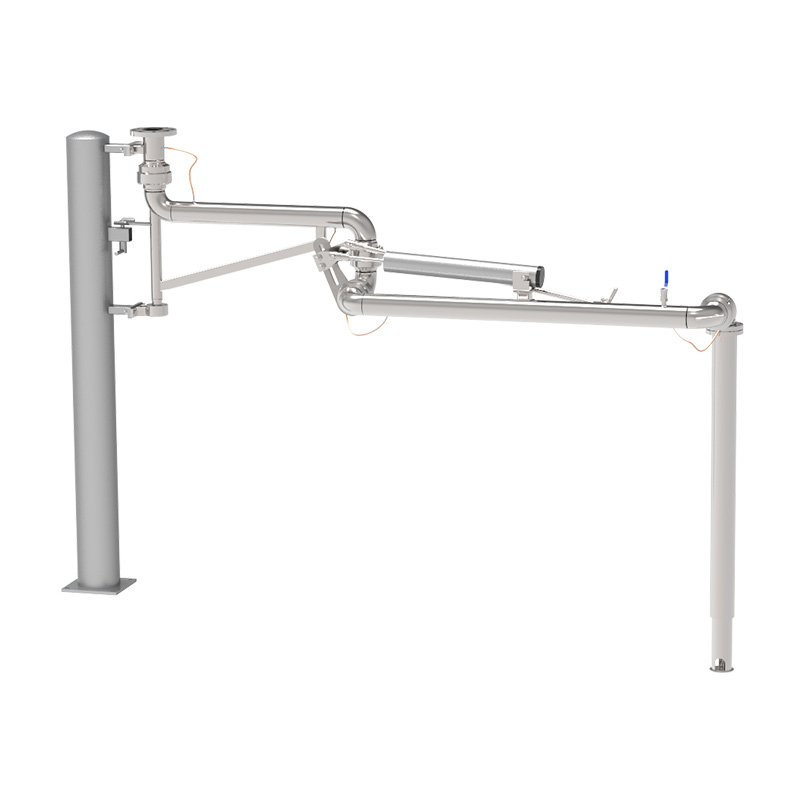
Piecing together individual components often leads to catastrophic compatibility failures. Understanding the integrated architecture ensures secure operations. Below are the foundational components you must evaluate strictly.
Swivel Joints: These represent the heart of the movement. They are also the most critical potential failure point. They allow the rigid pipes to articulate freely. You must specify exact seal materials based on fluid corrosivity. Popular choices include PTFE or Viton to prevent chemical degradation.
Balancing Mechanisms: Heavy steel piping requires reliable mechanical assistance. Torsion spring cylinders offer robust, low-maintenance balancing for standard trucks. Pneumatic or hydraulic systems handle heavier, long-reach marine configurations. They ensure smooth, predictable movement across all axes.
Safety Interlocks and Breakaway Couplings (ERC/DRC): Transport vehicles sometimes pull away prematurely. Emergency Release Couplings (ERC) and Dry Disconnect Couplings (DRC) act as critical fail-safes. They automatically seal both ends of the pipe and separate immediately. This prevents catastrophic pipeline ruptures and massive chemical spills.
Vapor Recovery Lines: Handling highly volatile petroleum products requires strict vapor management. These dedicated lines capture displaced gases from the tank directly. They route them back to a processing unit. This component remains essential for strict regulatory compliance.
Engineering teams need a strict decision framework before purchasing equipment. Evaluating these four parameters ensures successful physical integration.
Your transferred medium dictates the entire physical build. You must evaluate fluid viscosity, chemical corrosiveness, and precise operating temperatures. Highly corrosive acids require specialized alloys like Hastelloy or superior stainless steel. Extreme temperatures dictate specific elastomer seal selections. Choosing incorrect seals leads to premature melting or brittle fracturing.
Every terminal operates within unique spatial constraints. You must clearly define the working envelope. This includes the maximum horizontal outreach, vertical drop, and resting storage position. Accurate spatial mapping prevents the new equipment from clashing. It stops collisions with existing terminal infrastructure, overhead canopies, or adjacent loading bays.
Pumping liquids too fast through undersized pipes creates severe hazards. You must size the pipe diameter correctly. Proper sizing prevents dangerous fluid cavitation. It also mitigates violent pressure surges, commonly known as water hammer. Severe water hammer can physically tear pipes away from their concrete foundations.
Modern equipment cannot operate in a vacuum. It must communicate seamlessly with your current terminal automation software. Verify compatibility with existing batch controllers early. Ensure integration with electronic grounding monitors and automated overfill prevention systems. This creates a unified, fail-safe operational loop.
Common Mistake: Ignoring minimum ambient temperature drops during harsh winter months.
Best Practice: Always over-specify seal temperature ratings by at least 10 percent to ensure structural elasticity.
Even the best design fails if the execution falters. Managing project risks requires partnering with a proven supplier.
Custom engineering demands significant time. Fabrication and installation often create operational gaps. You must manage this timeline aggressively. Plan phased rollouts to minimize terminal downtime. Keep secondary bays active while upgrading primary lanes sequentially.
Never accept heavy equipment without rigorous testing documentation. Insist on comprehensive Factory Acceptance Testing (FAT) physically. Request documented hydrostatic testing results. Demand non-destructive examination (NDE) reports for all critical pipe welds. These documents prove structural integrity before the unit ever arrives on site.
Mechanical parts inevitably wear down over time. Swivel seals and internal bearings require routine replacement. Evaluate your supplier's ability to provide rapid spare parts delivery. Supply chain bottlenecks for a simple fifty-dollar seal can halt a massive operation. Guarantee local inventory access.
Audit a manufacturer's portfolio thoroughly before signing a contract. Ask for proven installations operating in similar climactic conditions. Request references from terminals handling identical chemical fluids. Real-world longevity proves engineering competence far better than a polished sales brochure.
Upgrading your fluid transfer infrastructure transforms operational efficiency and risk management completely. It goes far beyond a simple hardware purchase. You are making a critical investment in terminal safety, operator well-being, and strict environmental compliance. Modern articulating systems protect your workforce from severe physical injury. They shield your local environment from toxic emissions consistently. They also ensure long-term, uninterrupted commercial continuity.
Do not wait for a catastrophic hose failure or a severe regulatory fine to force an upgrade. We encourage you to act proactively today. Request a comprehensive site audit from qualified structural engineers. Submit your precise technical specifications, including fluid types, flow rates, and site layout data. Schedule a custom engineering consultation to secure your terminal's operational future.
A: The rigid steel or aluminum structure often lasts 15 to 25 years in standard environments. However, wear parts require frequent attention. Swivel joint seals, torsion springs, and bearings degrade based on usage intensity. With proactive, routine seal replacements, the core structural longevity remains exceptional.
A: Yes, but it requires substantial planning. You must update existing piping infrastructure and install new pumping mechanisms entirely. Space requirements differ significantly at ground level. You also need a transport fleet equipped with compatible API valves. A thorough engineering survey determines specific retrofit feasibility.
A: A hose uses flexible, heavy rubber prone to kinking, wearing, and bursting under pressure. In contrast, an arm utilizes rigid, articulated metal piping. It supports its own weight via mechanical balancing mechanisms. This design provides superior flow rates, longer lifespans, and eliminates heavy lifting.
A: Replacement schedules depend entirely on fluid abrasiveness and daily cycle frequency. Non-corrosive fluids might allow three to five years between changes. Highly corrosive or abrasive chemicals require annual replacement. Always follow proactive maintenance schedules rather than waiting for visible fluid leaks to appear.


